
A celestial black titanium wedding set built around lunar meteorite and alexandrite, made to survive hands-on work and all of life's adventures.
Some of what crosses our bench doesn't come from this planet. You might remember the wedding band we built from Kapton foil flown on Apollo 11, one of the most stressful builds we've ever done. There's no reordering a piece of a moon mission if something goes wrong. Space material only exists in the amount that made it to Earth, and that's all there will ever be. That same high-stakes feeling came back around with a lunar meteorite, which this time was worked into a matching wedding set for two friends of Honest Hands, Zac and Danielle.

Zac is an old friend and collaborator we've worked with for years. He owns IPF Racing, a Michigan shop that builds rare and hard-to-find automotive parts through reverse engineering and 3D scanning. He's on his feet with equipment all day, just like we are. One recent project together turned into one of our favorite collaborations yet. We cut a section from a customer's elk antler mount for a set of wedding bands, then Zac laser-scanned that exact piece and printed a replica to slot back into place.
When it was Zac and Danielle's turn to get married, they wanted a wedding that felt like them. That meant incorporating the night sky. They came to us wanting cohesive black wedding bands. When they told us their idea, we made a game plan knowing we had two real problems to solve, not just two rings to make. Danielle’s band needed a solution for the black finish on her existing wedding band, which kept wearing away no matter how careful she was. Zac’s band needed to survive workdays that include gripping tools, catching edges on machined parts, and going in and out of work gloves more times than he can count.
Danielle's problem wasn't unusual, just usually ignored until it's too late. Plating is a thin layer on top of another metal, and it eventually wears through no matter how carefully it's applied. Dark colors like black usually go first, showing the metal underneath before a lighter finish ever would, which is exactly what happened to her ring. Really, the only way to get black that holds up for good is black titanium. Since you can't cast titanium, you have to machine it from a solid blank.

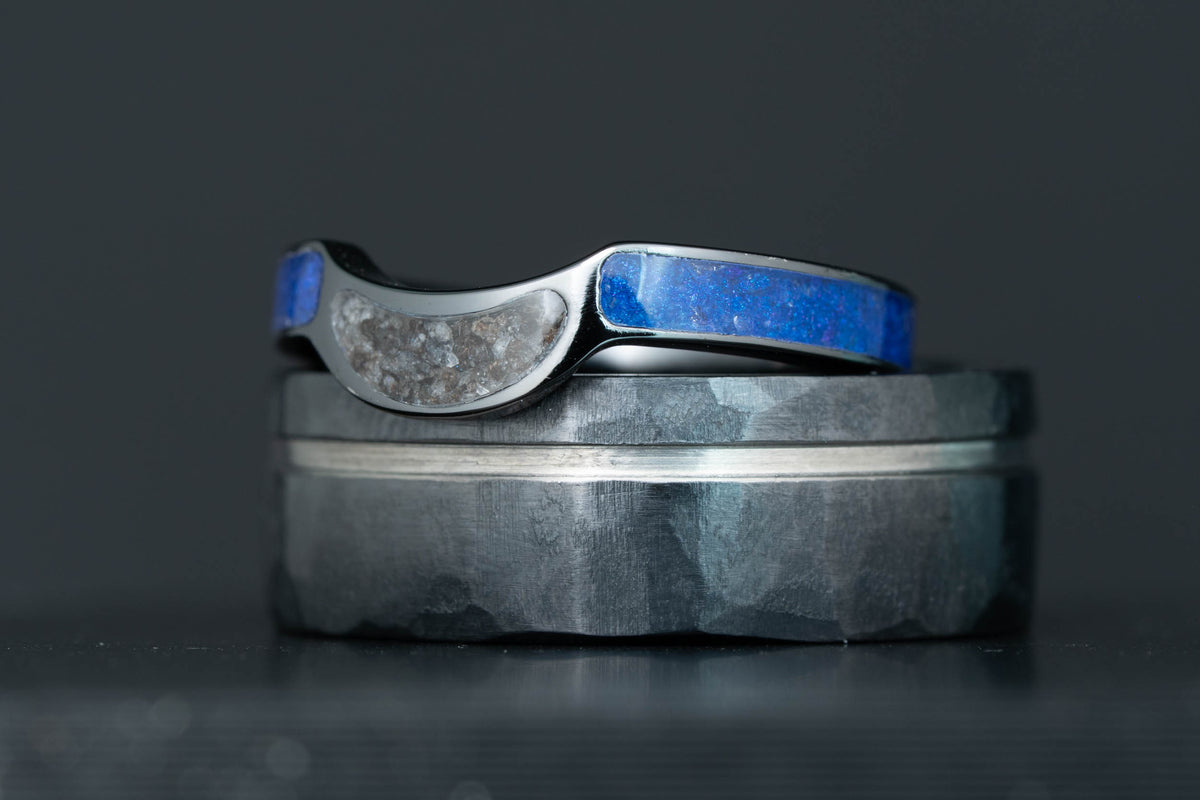
Danielle's band isn't a flat ring with a straight edge, the way most bands are built. The top edge dips and rises in a wave, like a single ocean swell frozen mid-motion. Inside that dip sits a crescent-shaped setting, cut low enough to hold the lunar meteorite without it sitting proud of the band. Where the wave levels back out into the flat part of the ring, that's where the alexandrite takes over, running the rest of the way around.
The alexandrite shifts with the light, blue-green in daylight, warming toward a deep purplish red under incandescent light. That shift earned the stone its nickname: emerald by day, ruby by night. The meteorite has an origin story of its own: rock broken loose from the moon by an ancient impact, carried across space, and eventually landing on Earth. It sits dark and pitted in its crescent, pockmarked like the moon's surface, with tiny craters instead of the flat shine you'd get from a cut gemstone.
Zac's ring is simple by design. Black titanium hammered instead of smooth, since scratches show up fast on hands that spend the day gripping wrenches, feeding metal through a mill, and catching the occasional sharp edge before a part is fully deburred. Zac is exactly the kind of guy we build rings for, people whose hands don't get a day off. We cut a single offset line into the surface to reveal the raw metal underneath, a thin strip of contrast against the black.

Both rings share a black titanium base, which is the real trick behind any matching set. They’re not identical rings, but they share one material doing different jobs across two different designs. Hers carries the alexandrite and the meteorite; his stays simpler with just the offset line breaking up the black. Two parts of the same story.
More couples are forgoing the traditional look, the same neutral palette, the same string lights, the same handful of venues everyone in a given city seems to get married at, for something that's actually theirs, like a favorite era or a place they love. Zac and Danielle built their wedding around the night sky, celestial from the ceremony to the reception. That spirit carries onto the rings, long after the wedding itself. The materials and the methods made each ring durable enough to be a symbol of their wedding and commitment they can wear forever, wherever. To the moon and back.
Design and durability aren't mutually exclusive. Our Workbench Ring Designer lets you choose your material, inlay, and details, so you can build the ring you actually want and wear it every day, on Earth or somewhere out in space. Still working through the idea? Our team is a message away.


Leave a comment
This site is protected by hCaptcha and the hCaptcha Privacy Policy and Terms of Service apply.